Reading the Cityblock-Homeward deal
The Cityblock–Homeward deal was framed as a push into rural Medicare Advantage. Run through public CMS data and agentic workflows, the rural book at its center is shrinking — and the real opening is an integrated dual play.
- The deal was read as a push into rural MA, but the rural book at its center is shrinking: Blue Cross membership across the footprint is down about a fifth since early 2025.
- The real opening is an integrated dual play across 33 Northern Lower Peninsula counties, with Michigan’s integrated-duals transition live as of January.
- Built from public CMS data plus parallel research agents and the Aequalis platform in an afternoon — competitor books, carrier-share shifts, and the openings between them.
In late June, Cityblock Health announced its acquisition of Homeward Health. Most coverage framed it the same way: a Medicaid and duals-focused organization pushing into rural Medicare Advantage. That read is accurate as far as it goes. It also skips the questions a growth or corporate development team would actually ask: what service areas are in play, which payer relationships Cityblock is growing into, and whether the patient book it is buying is even growing. We ran the deal through our own data and agents. What came back cuts against the headline. The rural book at the center of it is shrinking, not booming.
With those questions in mind, the deal made a useful case study for how we are using AI at 3Pillars, and how partners and other healthcare teams can run the same play. Work like this used to take weeks of digging through announcements and stitching together disparate data files, usually on top of some inside knowledge of the organizations involved. With the right structured-data environment and the right agentic workflows, that timeline collapses to an afternoon.
Start with the service areas. Homeward is a value-based provider, not an insurer, so it holds no CMS contract of its own and surfaces in none of the public enrollment files you would normally consult. We worked around that gap in two steps. First, we scoped a project plan for Claude research agents to run in parallel, each interrogating primary sources independently and then cross-validating against the others, to triangulate which payers Homeward's patients actually sit under, confirmed county by county. That narrowed the footprint to a specific set of forty-eight Michigan counties across Aetna and Blue Cross Blue Shield of Michigan, and it flagged where Homeward had exited counties and partnerships before. Then we handed the geography to Claude Code, connected via Model Context Protocol (MCP) to our Aequalis platform, which holds every Medicare Advantage and Medicaid plan, county, enrollment count, benefit, and Star rating data set CMS and local state agencies publish. Aequalis supplied the raw numbers, the agents supplied the geography, and the two reconciled into a single county-level view. Establishing Cityblock's own service area took a similar pass.
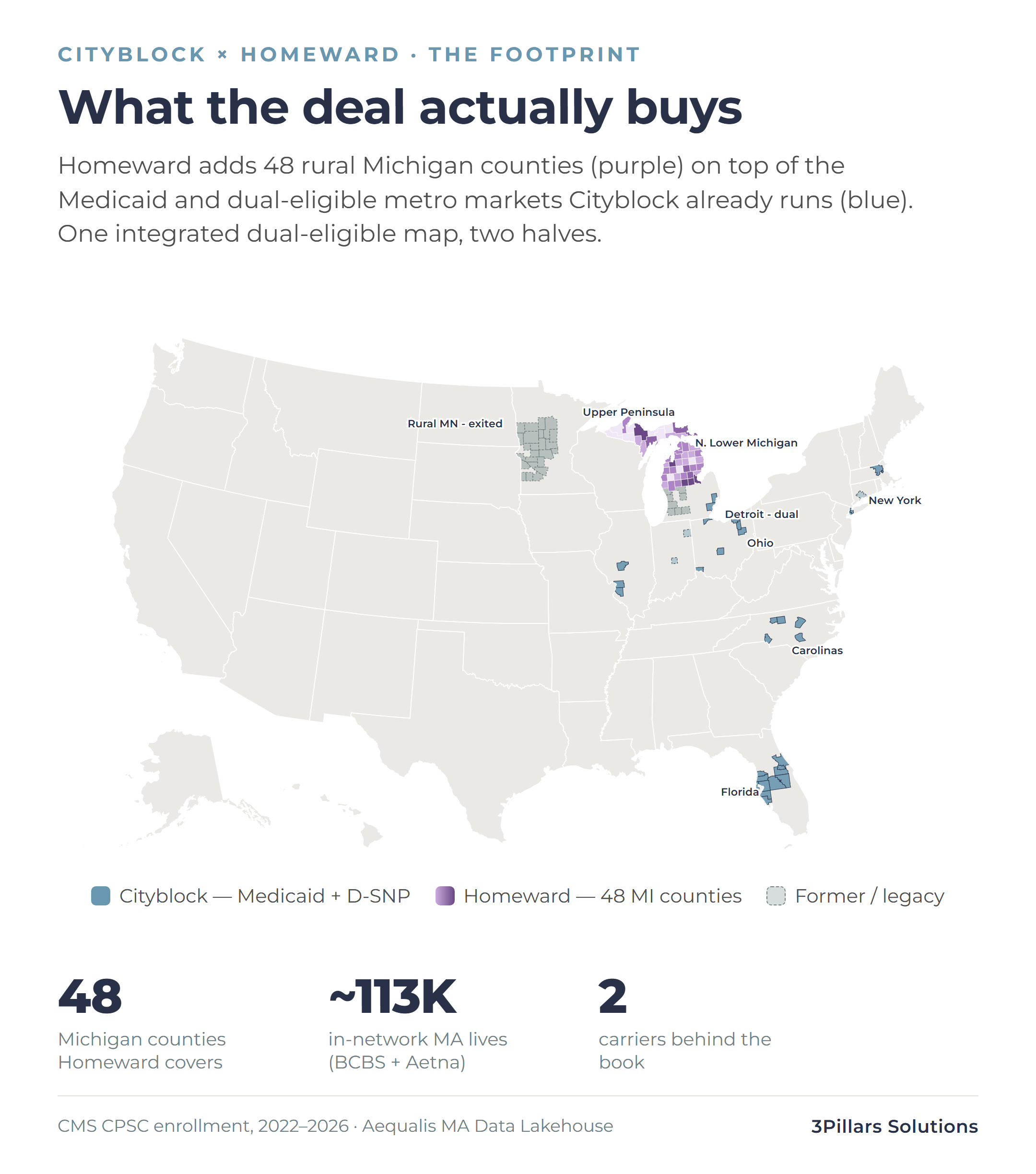
Here is the part of the process where we consistently see teams and organizations fail. It is not enough to let an LLM or an agentic workflow hand you an output and call it done. The initial report has to go back under a human lens, applied by people who carry the "insider" context the model does not. Having worked with several Michigan organizations through 2025, we knew the start of this year marked a real shift, as the formal SNP transition off the MMP demonstration finished. We also knew Blue Cross had pulled back from the MA market.
So what did the data show?
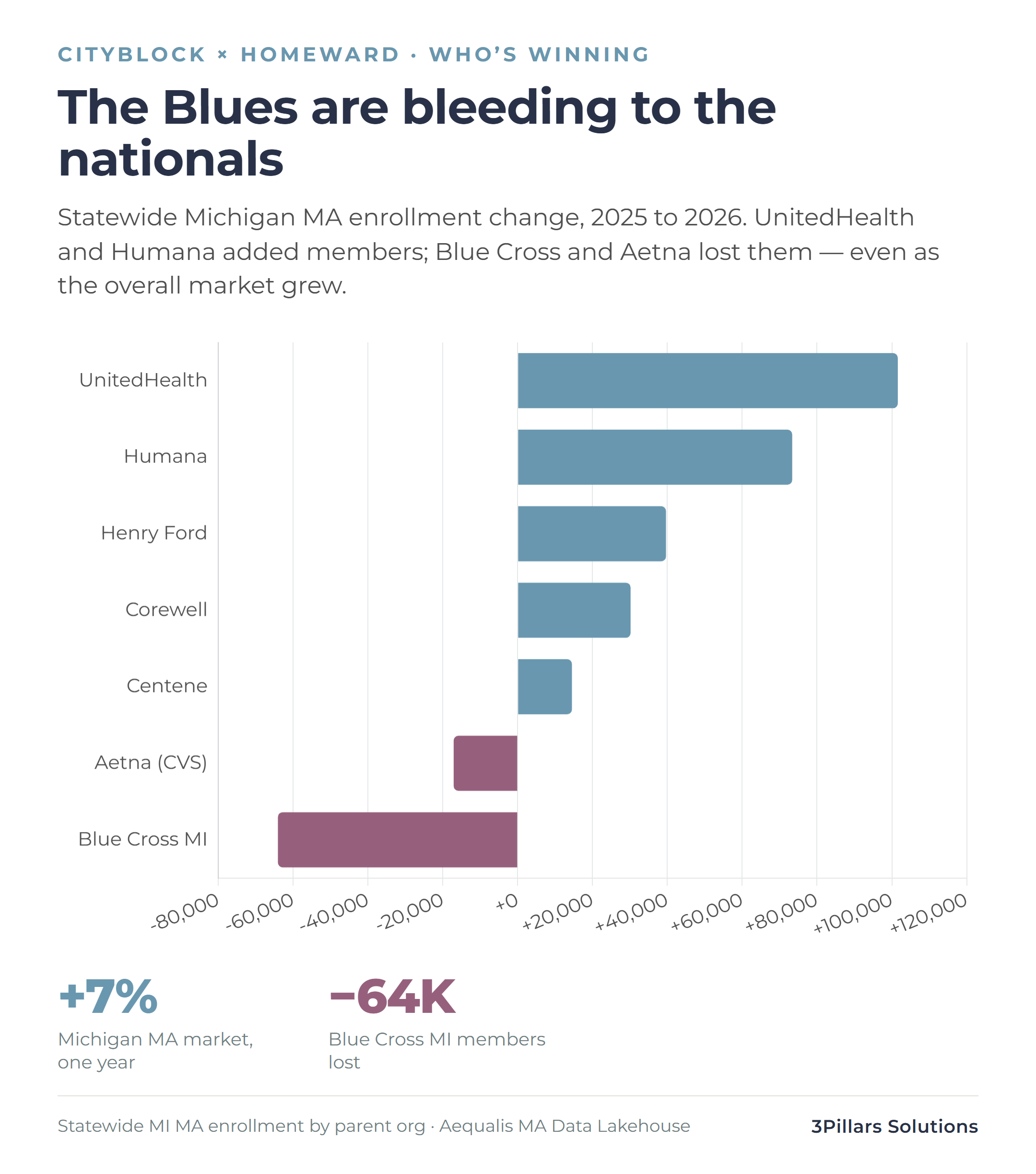
On the surface, Homeward looks like it rests on a large, healthy Blue Cross book. The county-level trend says the opposite. Across the rural footprint, Blue Cross's membership is down about a fifth since early 2025, and most of what it shed moved to UnitedHealth and Humana even as the broader Michigan market grew. Read plainly, Cityblock is buying a retention problem, and that reshapes how it would operate or expand across rural Michigan.
The Medicaid picture points at the opening. Across the 33 Northern Lower Peninsula counties in Homeward's footprint, Blue Cross sits on both sides of the dual-eligible population: the Medicaid book through Blue Cross Complete, and the Medicare members Homeward already manages. What is not there is a D-SNP to formally bridge the two. The vehicle for exactly that bridge, Michigan's integrated-duals transition, went live this past January. So the opening is real: an integrated dual play across 33 counties, with the regulatory timing finally lined up.
Aetna runs the opposite pattern. It carries no Medicaid in Homeward's rural counties, yet it concentrates both its Medicaid book and a fast-growing D-SNP in metro Detroit; roughly half of its statewide dual membership sits in Wayne, Oakland, and Macomb, right where Cityblock already operates. So the deal arguably hands Cityblock two different Michigan plays: a rural retention play on Blue Cross, and an urban dual-growth play on Aetna.
One thread we pulled but will not unspool here. We ran the same lens on Cityblock's own payer book, and four of its seven active states run through a single parent. That is the next post.
All of this came from an outsider's vantage, and it came together in an afternoon, with no data-engineering ticket and no queue. If you run growth or strategy at a plan, or corporate development at a fund, this is the read we build: competitor books, carrier share shifts, and the openings between them. If that maps to how you are weighing a market, reach out.
Enrollment figures from CMS CPSC enrollment files via Aequalis; February 2025 compared with the latest available data, May 2026.